The U.S. office real estate market demonstrated resilience in the second quarter of 2025, as stakeholders adapted to evolving workplace trends and shifting tenant needs. Despite ongoing challenges, several key indicators point to a gradual recovery.
Absorption and Vacancy Trends
Net absorption remained positive for the fifth straight quarter, even as new supply continued to outpace demand. The national vacancy rate held steady at 19%, but a closer look reveals a flight-to-quality trend: prime buildings saw vacancies drop to 14.5%, while non-prime space rose to 19.4%, according to CBRE.
Leasing Activity
Leasing activity increased quarter-over-quarter, led by financial services and technology firms. Spaces between 10,000 and 20,000 s.f. accounted for more than half of leases signed, according to CBRE.
Newmark estimates 49% of pre-pandemic leases have yet to expire, leaving 1.4 billion s.f. scheduled for renewal between 2025 and 2027. While this presents a challenge, 69% of tenants plan to maintain or expand their footprints, signaling optimism.
Development Trends
The construction pipeline contracted to 21 million s.f., with 6.3 million s.f. scheduled for delivery this year — the lowest annual total in over a decade, according to CBRE.
The 15 leading markets had 21.6 million s.f. under construction midway through the year, with 58.9% of the pipeline preleased, according to Colliers.
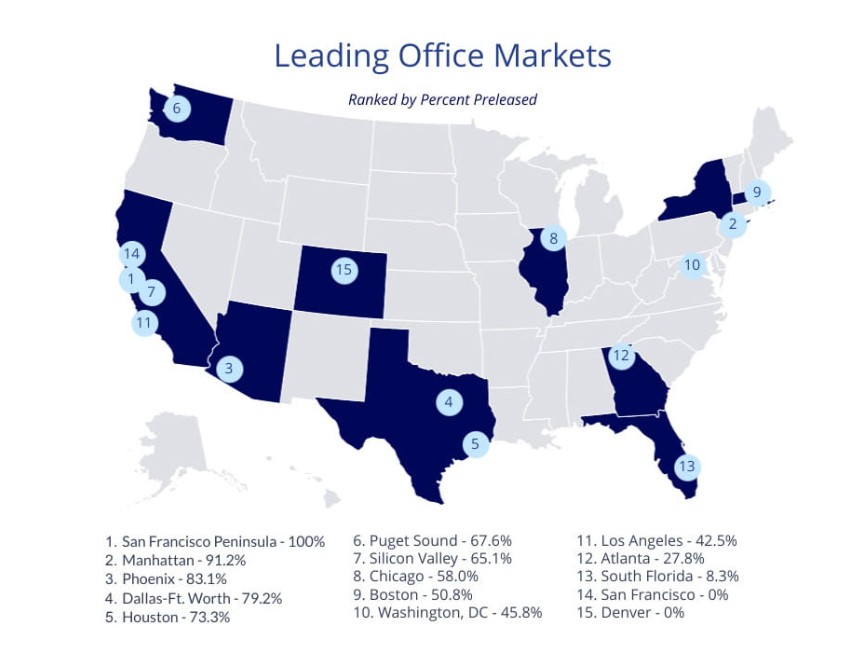
Developers are adjusting pipelines in response to evolving demand, which may help limit future vacancy growth and support property values, according to Newmark.
Both CBRE and Colliers suggest preleasing and a shift toward build-to-suit projects and away from speculative builds are becoming standard strategies.
Rents and Concessions
Average asking rent rose nationally by 1.1% year-over-year to $36.21 per s.f., CBRE reports. However, rising tenant concessions are compressing effective rents, according to Newmark. Improvement allowances now average 68% above pre-pandemic levels, meaning landlords may collect higher nominal rents but not necessarily more income.
Avison Young found that concessions accounted for 26% of lease terms in Q2 2024. For example, a tenant paying $100 per square foot would receive $26 per square foot annually in free rent and improvement allowances.
Employment Landscape
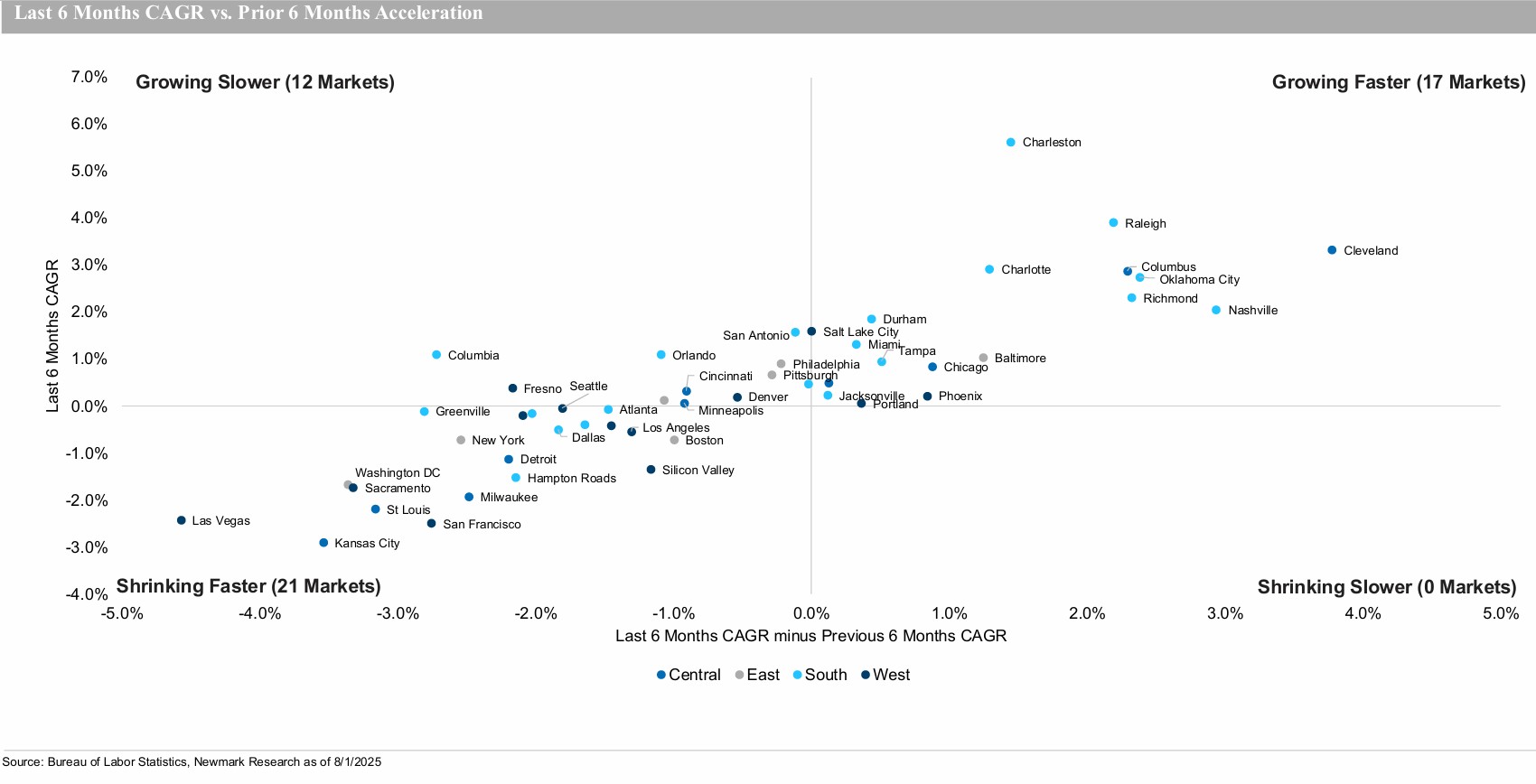
Office market performance remains closely tied to employment trends. Newmark reports slower job growth in 33 markets over the past six months, though sectors such as education, health care and government continue to add jobs.
Demand Drivers
Demand is strongest for high-quality, well-located buildings. Class A and “trophy spaces” with modern amenities are commanding premium rents as companies seek environments that encourage employees to return to the office, according to NAIOP.
Julie Whalen, head of occupier research at CBRE points out that opportunities to upgrade lower-tier properties exist due to much of the existing Class A inventory being already leased, while Mike Watts, president of Americas office investor leasing at CBRE highlights the importance of accessibility and proximity to where employees live.
Return-to-Office and Hybrid Work
Return-to-office policies are evolving. California now requires state employees to work in-office at least four days a week, with Philadelphia and Washington, D.C., considering similar mandates, according to CoStar.
JLL reports a shift in sentiment: while 77% of commercial real estate decision-makers supported hybrid work in 2022, today 44% prefer full-time office attendance.
Co-working spaces are also regaining popularity, offering flexible options such as tenant lounges and reservable desks, according to NAIOP.
In Summary
The U.S. office market is gradually recovering, supported by sustained positive absorption, a rebalancing of supply and demand and a shift toward quality assets. Developers are responding to changing demand with more targeted construction strategies, while tenants remain cautiously optimistic about maintaining or expanding their space. Although vacancy rates are still high and concessions are impacting effective rents, the market is adapting, with evolving work policies and a renewed focus on premium office environments shaping the path forward.