The pandemic led to a decline in the need for office space as companies adopted remote and hybrid work models. Even as cities such as Los Angeles and San Francisco implement return-to-office initiatives to revive downtown economies, office vacancies remain high while leasing and sales activity lag.
But it’s not all doom and gloom for building owners:
- Net absorption – the amount of office space newly occupied in a quarter versus the amount newly vacated – has been positive for the past four quarters and office leasing activity increased 18% in the first quarter from a year prior, according to CBRE.
- Office delinquency rates have begun to decline, according to a JLL report.
Still, vacancies are at an all-time high of 19%. While widespread factors such as high rent, the cost of living and uncertainty around federal employment decisions contribute to the trend, regional issues are also playing a role. In Los Angeles, for example, reduced filming activity in the entertainment industry is lowering office demand. Filmmakers are opting for other locations to take advantage of tax incentives and avoid rising costs for permits, location fees and studio space.
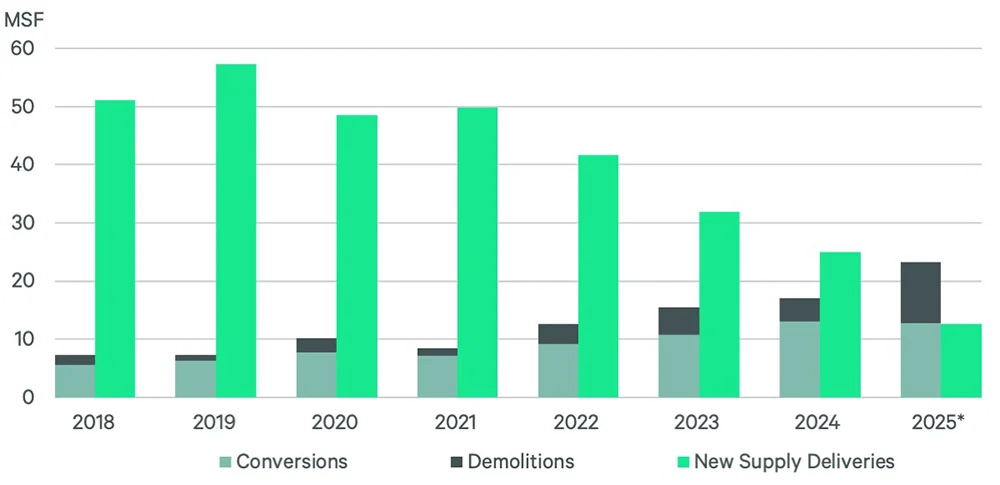
Overall, the downward trend in office space demand has pushed building owners, developers and cities to get creative. As a result, conversions and demolitions have been on the rise, and for the first time in several years, CBRE reported they will exceed new construction in 2025.
In a report analyzing office market activity across the 58 largest U.S. markets, CBRE found 23 million square feet of office space planned for conversion or demolition this year – surpassing the 12.7 million s.f. of new construction anticipated for 2025.
Not all buildings are suited for repurposing; most demolitions involve older, less adaptable structures. For buildings that are candidates for conversion, however, the trend is expected to continue, with developers planning 81 million s.f. of office space for conversion to other uses in future years.
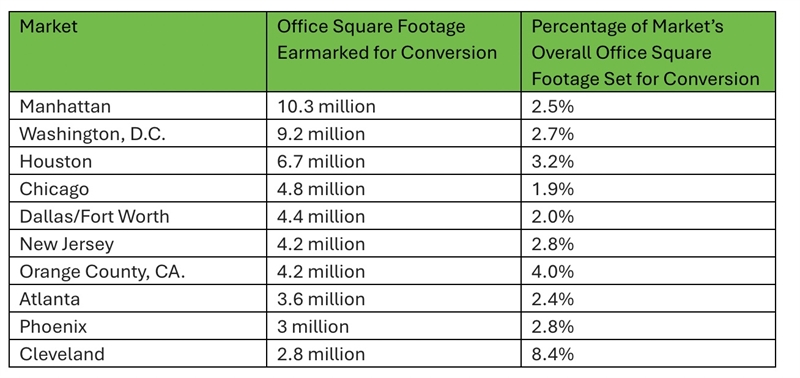
Conversion activity varies by market. Manhattan, Washington, D.C., and Houston have the most square footage planned or under construction for conversion in 2025, while cities such as Cleveland and Cincinnati have the largest percentage of overall square footage in the market under conversion.
Multifamily complexes are dominating conversion projects, accounting for 76% of activity, followed by hotels, life science labs, industrial and other uses. But it doesn’t end there.
In the second quarter of 2025, the Prebys Foundation purchased 401 B Street in downtown San Diego. The foundation aims to transform the property into a hub for business, arts and community engagement. The creative reuse of this space could serve as a model for reimagining other downtown office properties for mixed and community use in the future, according to a report from Kidder Mathews.
Every solution comes with challenges, and office space conversion is no different. Building age, floor plate size and location will always be a factor in whether a building is a viable option for conversion. Additionally, rising construction costs, interest rates and the need for a more favorable economic environment could influence the pace and feasibility of future projects. So, while conversions are not a complete solution to declining office space sales, they present a promising avenue and will remain a focus in the future.