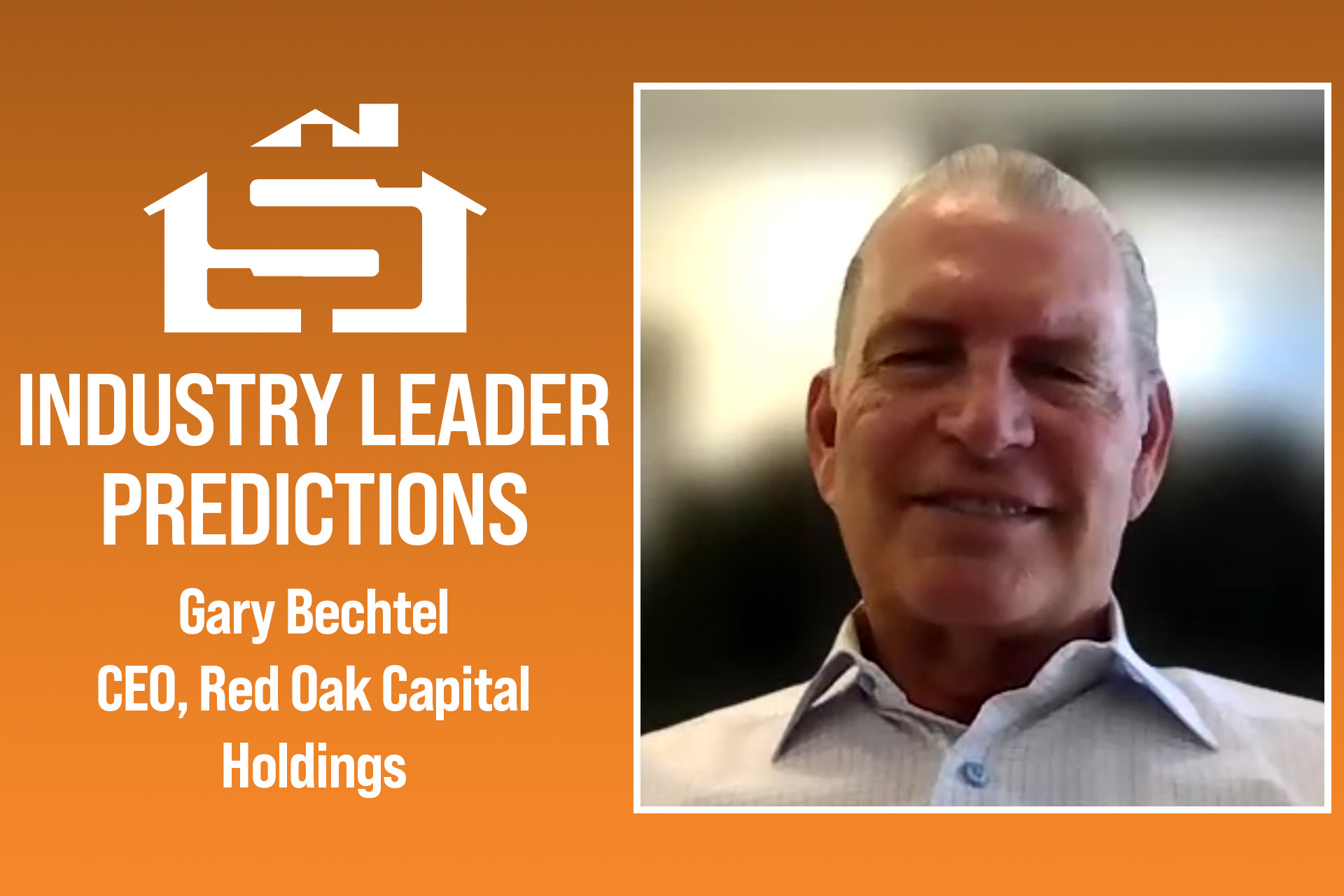
Earlier this year we sat down one-on-one with Gary Bechtel, CEO of Red Oak Capital Holdings, one of the top leaders in the commercial real estate industry. He told us what was in store for 2025 and discussed his thoughts on the 2025 MBA CREF Conference, predictions for rates, underwriting changes, bridge lending trends, plus advice to borrowers.
Full transcript below (lightly edited for clarity):
Can you give us an overview of Red Oak Capital Holdings and your background?
Red Oak Capital Holdings is a multi-fund manager. We raise and deploy capital in a series of funds, primarily in bridge loans backed by commercial real estate. I’ve been in the commercial real estate finance business for 39 years. Started out in the commercial mortgage banking brokerage business, representing life insurance companies and pension funds. And for the last 10 years, I’ve been specifically involved in the bridge lending space. Prior to joining Red Oak, I was president of another bridge lending platform called Money 360, where we did almost $2 billion of volume from 2015 till March of 2020 when COVID hit. And then I joined Red Oak in August of 2020, and we’ve built this platform and done about $400 million since I joined the platform. So I’ve been in the business a long time, seen a lot of changes since 1986. “The good, the bad and the ugly,” as they say. But it’s helped us build the business and rely on some of those experiences through the probably 8 or 9 cycles that I’ve been through now.
What are your overall thoughts about the MBA CREF Conference this year?
It was pretty positive this year relative to maybe 2024. I think the general takeaways are that there’s going to be more capital looking to be deployed in 2025 maybe than there was in 2024. I think in ‘24 versus ‘25, there was maybe a little bit of uncertainty in the market relative to capital availability and interest rates. I think that was somewhat driven by an interest rate environment and somewhat driven by an upcoming election in ‘24. That’s all behind us now. I don’t think there’s as much uncertainty relative to interest rates. I think everybody is of the opinion that the interest rate environment we’re in is the interest rate environment that we’re likely going to be in, at least for the near term.
I think the outlook for Fed cuts is pretty much cemented — at least in my mind — that you’re probably not going to see any, or maybe one. There’s a number of factors that go into that, but I don’t think there’s any — or very little — pressure on the Fed to drop rates anytime soon. So I think the rate environment that we’re in is likely the rate environment that we’re going to be in for the foreseeable future. And look, again, I’ve been in the business a long time. If you look historically, the rate environment we’re in today, relative to where treasuries are, and relative to where long-term interest rates are, when you look at a life insurance company or a bank, how they’re pricing their loans, those are pretty good rates historically. When you’re looking at rates in the high fives and low-to-mid sixes, those are pretty good rates. So if you can’t make a deal work on those interest rates, maybe it’s not a deal that you should be pursuing. Again, I think capital availability is going to be much better this year than last year, both on the long-term side and the short-term side. We’ve seen interest from a number of long-term players coming back into the market. A lot of capital was raised last year, wasn’t deployed last year. I think some of that, a lot of that money is going to come into the market.
On the bridge lending side, the short-term lending side, the construction side, I think a lot of that money is going to come back into the market and be deployed. You have seen a fall in SOFR from where it was, say, a year ago. You know, a year ago, SOFR was in the low fives, call it 530, 535. That’s come in dramatically. We’re now looking at SOFR rates in the 430s. So that makes some of these construction loans and bridge loans pencil a little easier. And if you look at the forward yield curve, SOFR is expected to go down a little bit over the next 12 months. I think the forward yield curve says a year from now, SOFR looks like it’s maybe in the 380s, 390s. We’ll see. I think that helps some of these construction deals pencil a little bit better, but that’s subject to their takeout financing. And the forward yield curve on treasuries isn’t as optimistic; it’s essentially flat. Those are going to still be constrained by their takeout loans. But look, I think the answer to your question is, I think the interest rate environment we’re in is the interest rate environment that we’re likely going to be in for this year. I think capital availability will be much better than it was last year, both on the long-term side and the shorter-term side, both construction and bridge, which is what Red Oak and its affiliated company, Oak Real Estate Partners, provides. I think if you’re a borrower, it’s going to be a good year if you need financing for your properties.
What were the hot topics everyone was talking about? What is everyone worried about in 2025?
Bullet points are, while there’s capital availability, the underwriting is still key. And I think lenders are going to be very focused on their underwriting, their underwriting standards. While there’s more money, it’s not dumb money. And so people are going to be very cognizant and very focused on underwriting transactions and not kind of “getting over their skis” relative to how they underwrite transactions.
The challenges that we’ve had, and I think will continue to have, and people have talked about and continue to talk about, are things like insurance and labor costs. Those continue to impact transactions and will continue to impact transactions. And we’re actually seeing, unfortunately, an expansion of those issues in certain states. Insurance started as an issue in Florida, then went to California, now we’re seeing it in states like Texas and Colorado. And so I think that’s going to be an issue that is ongoing.
Labor costs have been there and will continue to be there. And so those are impacting the operating expenses, especially in the multifamily sector, for example. Those are things that are front and center that we as lenders look at and as operators need to look at. There was a lot of discussion around underwriting. There was a lot of discussion around expenses, operating expenses, and trends in those things at the conference and in meetings that I had one-on-one with both other lenders and intermediaries that we met with.
What is your main piece of advice for borrowers/owners?
Pick the right intermediary to work with and pick the right lender. I’ve said this a number of times over the years, as markets expand and new lenders come into the market, people have the ability to raise a lot of money, but that doesn’t necessarily mean that they’re a lender that you necessarily want to do business with. You need to vet your lender. Do a good job of vetting your lender, especially on the construction and interim side, because you may get a great deal and you may save 5 or 10 basis points with a, with a bridge lender, for example. But if you can’t get a construction draw because your lender doesn’t have the back office or back office support, or they for some reason lose their funding, that impacts your ability to successfully execute your business plan. That five-basis-point or 10-basis-point advantage in pricing gets evaporated pretty quickly. So my advice to borrowers is pick the right intermediary to clear the market for you and with their help, make sure that you pick the right lender and vet that lender to make sure that they are a reliable, viable source of capital for your project.
What are your predictions for the bridge lending space?
It’s going to be very active. I think, again, there was a lot of capital raised last year. There was, to a certain degree, a bit of a bid-ask gap last year between what borrowers were willing to pay and what we as bridge lenders were willing to put money out at. I think that’s starting to equalize a bit. By the way, we saw the same thing on the bid-ask gap between sales transactions. There’s a bid-ask gap between what buyers and sellers were willing to transact at. But on the bridge lending side, I think the bid-ask gap is narrowed relative to pricing. I think the bridge lending space is going to be pretty active this year. We’ve already seen a tick up in our volume for the months of January and February, year over year from January of ’24, so we anticipate a pretty active market this year. And that’s been echoed by other bridge lenders that I’ve talked with down at MBA.
What property types will be hottest this year? What will be the toughest to finance and why?
I think it’s going to be consistent with what we’ve seen the last couple of years. Multifamily and industrial are going to continue to be the darlings, followed by probably retail, self-storage, manufactured housing, hospitality. Look, I don’t need to state the obvious: Office is going to continue to be challenged, especially urban office. That’s not an asset class that Red Oak or Oak Real Estate Partners are involved in.
But I think there are going to be some bright spots again. [Multifamily] and industrial are going to continue to do pretty well. You have seen some overbuilding in those two asset classes, but I think that’s beginning to absorb and they should do well this year. Smaller retail, anchored centers, big strip centers have done pretty well. Manufactured housing continues to be strong. Self storage in the right markets continues to be strong. Hospitality with the right flag in the right market continues to be strong.
Office is challenged, for all the reasons that we all know, and I think that’s going to be an ongoing issue. Suburban office actually has performed pretty well. Urban office, with the work from home, although that seems to be changing a little bit more and more companies, including the federal government under the new administration, or asking people to come back to the office, you know, three to five days a week now, so that may change a little bit. But that’s a long road ahead of them. Office will continue to be challenged. There’s a lot of work there left to do. That’s an asset class that we’re staying away from to a large degree. But I think that’s an obvious one in most people’s minds.
I think this is going to be a good year. We’re really looking forward to a good 2025. 2024 was challenging in a number of ways. We had an okay year. I’ll just say that. We’re looking to put ‘24 behind us and put out a lot more money in 2025, and I think we’re going to be able to do that. I think everybody that I’ve talked to, both on the lending side, the borrowing side and the intermediary side, is kind of saying the same thing. Everybody’s positive. There was a lot more optimism down in San Diego, so that’s a good way to start the year.