
The outlook remains optimistic for commercial real estate lending in 2025. Strong year-over-year Q1 growth suggests long-term confidence in key segments of the market, despite a decline from Q4 that was driven by seasonal trends, higher interest rates and market uncertainty.
Year-over-year loan originations rose 42% in Q1 2025 for commercial and multifamily real estate, according to Mortgage Bankers Association (MBA). While there was an expected seasonal decline from Q4 2024, year-over-year growth suggests renewed confidence in CRE lending, with buyers and lenders moving new deals forward.
Specifically, a year-over-year rise in originations for office, health care and multifamily led to an increase in loan dollar volumes in key segments of the market, according to MBA. There was a 205% increase for office properties, a 159% increase for health care properties, a 39% increase for multifamily properties and a 30% increase for hotel properties.
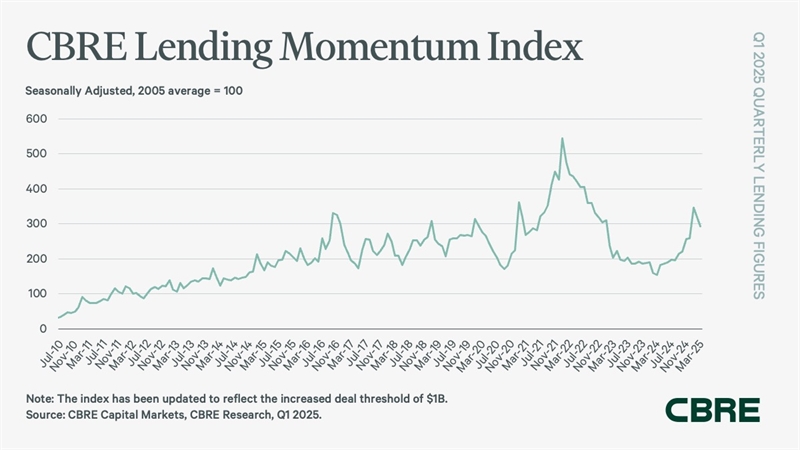
CBRE commercial loan closings rose 13% from Q4 2024 and 90% year-over-year. Additionally, the CBRE Lending Momentum Index surpassed three hundred for the first time since Q1 2023, with a Q1 2025 close at 292, despite market volatility in March.
Commercial mortgage loan spreads tightened in Q1 2025, averaging 183 basis points — down 29 basis points year over year and 1 basis point from the fourth quarter of 2024. Multifamily loan spreads narrowed by 7 basis points to 149, the lowest since the first quarter of 2022. The shift opens the door for early refinancings, accretive debt for acquisitions and new opportunities to move deals forward, according to CBRE.
While agency financing remained consistent for CBRE in Q1 2025, banks led their non-agency loan closings, followed by CMBS, life companies and alternative lenders such as debt funds and real estate investment trusts (REITs). The rise in non-agency multifamily deals stemmed mostly from floating-rate bridge or bank financing, offering borrowers greater flexibility and reflecting a favorable regulatory environment and strengthened balance sheets.
While market volatility is always a factor, strong year-over-year growth suggests long-term confidence in key segments of the market for the remainder of the year, allowing for new opportunities for buyers and lenders.